
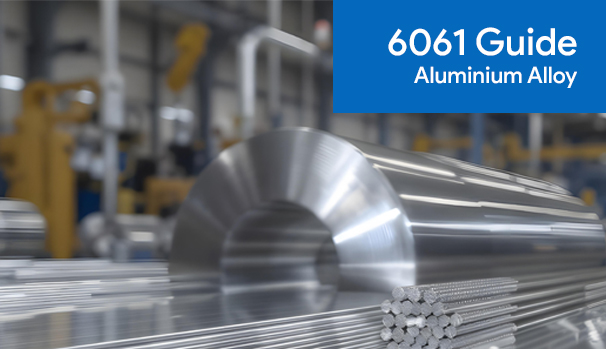
In Brief: 6061 aluminium is a versatile alloy widely used across aerospace, automotive, construction, marine, and industrial sectors. Its composition of aluminium, magnesium, and silicon gives it a balance of strength, corrosion resistance, and workability. Available in multiple forms such as sheets, plates, rods, and coils, it is often called the “workhorse alloy” because it delivers efficiency, durability, and adaptability across industries.
In modern industry, materials are not just chosen for availability but for the efficiency and performance they deliver throughout their lifecycle. From structural reliability to ease of fabrication and cost-effectiveness, every property matters. Among aluminium alloys, 6061 aluminium has emerged as one of the most dependable and widely used grades.
Known for its excellent balance of properties, 6061 aluminium is used in sectors as diverse as aerospace, automotive, marine, construction, and heavy machinery. It can be found in aircraft wings, vehicle chassis, boat hulls, and industrial pipelines—proof of its adaptability. In this guide, we will cover the composition, properties, applications, and comparisons that make 6061 aluminium a cornerstone material for industries worldwide.
Composition of 6061 Aluminium
The strength and versatility of 6061 aluminium alloy come from its carefully balanced chemical makeup. At its core, aluminium makes up most of the alloy—around 96%. To this base, other elements are added in controlled proportions: magnesium (around 1%) and silicon (around 0.6%) are the key strengthening agents, enhancing the alloy’s hardness, corrosion resistance, and overall durability.
Small amounts of copper (up to 0.4%) contribute to additional strength, while chromium (up to 0.35%) stabilises the structure and improves toughness. Trace elements like zinc, iron, and titanium are present in smaller fractions, typically below 0.25%. Together, this blend creates an alloy that balances strength, corrosion resistance, and machinability in ways that pure aluminium cannot achieve.
Key Properties of 6061 Aluminium
1. Lightweight Strength for Demanding Applications:
One of the defining features of 6061 aluminium is its excellent strength-to-weight ratio. It is considerably lighter than steel but still strong enough to handle structural loads in automotive frames, aerospace parts, and marine equipment. This reduction in weight translates to better fuel efficiency in vehicles, easier handling in construction projects, and more cost-effective transportation. In industries where weight directly impacts performance or operating cost, 6061 aluminium offers a critical efficiency advantage.
2. Corrosion Resistance and Long-Term Durability:
The magnesium and silicon in 6061 aluminium give it superior corrosion resistance, particularly in harsh environments. This makes it well-suited for outdoor structures, marine vessels, and industrial pipelines that are regularly exposed to moisture, chemicals, or saltwater. Unlike untreated steel, which requires frequent painting or protective coatings, 6061 aluminium naturally resists rusting. Over time, this durability reduces maintenance cycles, lowers replacement costs, and ensures longer service life.
3. Excellent Machinability and Weldability:
Another property that sets 6061 aluminium apart is its machinability. It can be cut, drilled, and shaped using standard tools without excessive wear or difficulty. Weldability is also a strong suit; the alloy can be welded using conventional methods while maintaining much of its strength. This makes it attractive for industries that require large-scale fabrication and complex assemblies. For example, automotive manufacturers benefit from the ability to quickly machine and weld 6061 aluminium into chassis components with minimal post-processing.
4. Heat Treatability and Versatile Tempers:
6061 aluminium belongs to the group of heat-treatable alloys. This means its properties can be enhanced through controlled heating and cooling processes, resulting in tempers such as T4, T6, and T651. The T6 temper, for instance, is especially popular because it provides higher strength and hardness, making it suitable for heavy-duty applications. This ability to tailor mechanical properties through heat treatment gives manufacturers the flexibility to match the alloy to specific project requirements.
5. Availability in Multiple Forms:
From 6061 aluminium sheets and plates to rods, bars, and coils, this alloy is available in nearly every form required by industry. Sheets and plates are widely used in construction and aerospace for their structural strength. Rods and bars are vital in machining and equipment manufacturing. Coils are preferred where continuous processing is required, such as roofing sheets or automotive panels. The sheer availability of 6061 aluminium across different product types is part of what makes it such a versatile choice.
Applications of 6061 Aluminium
1. Aerospace:
In aerospace, every gram of weight saved translates into higher efficiency and lower fuel costs. 6061 aluminium is widely used in aircraft wings, fuselage structures, and interior fittings because of its lightweight strength and resistance to fatigue. It can withstand high stress without deforming and is easy to machine into precision parts, making it indispensable for aircraft manufacturers.
2. Automotive:
Modern vehicles increasingly use aluminium to reduce weight and meet emission standards. 6061 aluminium plates and rods are used in engine blocks, chassis, and suspension components. These parts benefit from the alloy’s combination of machinability and corrosion resistance, ensuring both performance and durability. In electric vehicles, where weight reduction is critical for extending battery life, 6061 aluminium is playing an even greater role.
3. Construction and Infrastructure:
6061 aluminium sheets and plates are frequently used in bridges, pipelines, towers, and cladding panels. Their resistance to weather and chemical exposure makes them ideal for long-lasting infrastructure. In addition, the ability to weld and fabricate the alloy easily reduces construction time and labour costs, further improving project efficiency.
4. Marine and Offshore:
Saltwater corrosion is a constant challenge in marine engineering. With its natural corrosion resistance, 6061 aluminium is used in boat hulls, docks, masts, and offshore structures. Compared to steel, it offers lighter weight and easier maintenance while still providing the toughness needed to withstand marine conditions.
5. Industrial Machinery:
From hydraulic systems to heavy equipment parts, 6061 aluminium rods, bars, and blocks are extensively used in industrial machinery. The alloy’s machinability allows manufacturers to create precision components that can handle stress and wear while remaining cost-effective compared to other materials.
Comparisons with Other Aluminium Alloys
1. 6061 vs 7075 Aluminium:
7075 aluminium is stronger and used in military and aerospace applications where maximum strength is essential. However, it is less corrosion-resistant and harder to weld. 6061 aluminium offers a more balanced profile with better corrosion resistance and weldability, making it more versatile.
2. 6061 vs 2024 Aluminium:
2024 aluminium excels in fatigue resistance and is commonly used in aerospace structures under constant stress. However, it is more prone to corrosion than 6061. For applications requiring both strength and resistance to environmental exposure, 6061 is often the better option.
3. 6061 vs 6082 Aluminium:
Both belong to the 6xxx series and are widely used in structural applications. While 6082 is slightly stronger, 6061 has superior machinability and weldability, which often makes it more practical for general industrial use.
4. 6061 vs 5052 Aluminium:
5052 aluminium is known for its exceptional corrosion resistance, particularly in marine environments. While it is not as strong as 6061, it is often chosen for applications like tanks and marine hardware. 6061, on the other hand, provides a better balance of strength and versatility.
Why Choose 6061 Aluminium from Pratham Traders
As one of the leading aluminium suppliers in Mumbai and across India, Pratham Traders offers high-quality 6061 aluminium sheets, plates, rods, and coils in a variety of dimensions and tempers. Our strong inventory and efficient supply chain ensure quick delivery, while our technical expertise helps customers select the right grade for their projects.
Whether you are sourcing material for aerospace, construction, marine, or industrial applications, partnering with Pratham Traders guarantees both quality and consistency.
Final Word: The Workhorse Alloy of Modern Industry
6061 aluminium is more than just another alloy—it is the backbone of countless industries. Its combination of strength, corrosion resistance, machinability, and adaptability makes it the go-to choice for demanding applications worldwide. By working with trusted aluminium sheets suppliers and aluminium plates suppliers like Pratham Traders, businesses can unlock the full potential of 6061 aluminium while ensuring reliability, efficiency, and long-term success.
Frequently Asked Questions (FAQs)
1. What industries use 6061 aluminium in India?
6061 is used in aerospace, automotive, marine, construction, and industrial machinery. Its balance of strength, corrosion resistance, and weldability makes it popular across sectors.
2. Is 6082 aluminium the same as 6061?
6082 is often called the European equivalent of 6061, with similar strength and applications. However, the composition differs, so in India, substitution should only be done after checking project specifications.
3. What are the common tempers of 6061 aluminium?
6061 comes mainly in O, T4, and T6 tempers. O is soft and ductile, T4 is medium strength, and T6 is the strongest and most widely used in India for structural applications.