
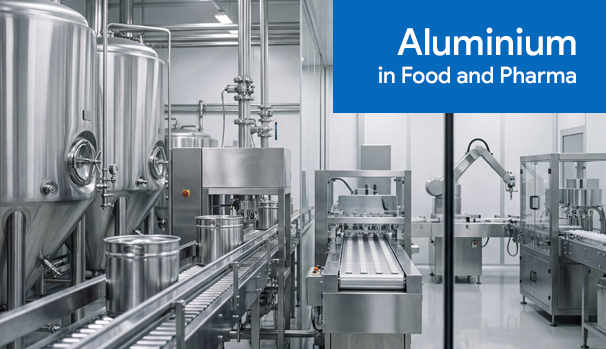
India’s food processing and pharmaceutical sectors are two of the country’s fastest-growing industries. Together, they serve billions of people — demanding materials that are not only strong and cost-effective but also safe, hygienic, and compliant with stringent regulatory standards. In both industries, the choice of material is far from trivial. A material that corrodes, reacts with chemicals, or harbours bacteria can compromise product quality, trigger regulatory violations, and, most critically, endanger human health.
Aluminium has earned its place as one of the most trusted materials across both sectors. Its unique combination of corrosion resistance, non-toxicity, thermal conductivity, light weight, and formability makes it exceptionally well-suited to the demanding environments of food processing plants and pharmaceutical manufacturing facilities. From storage tanks and conveyor systems to packaging foils and equipment components, aluminium is present at virtually every stage of both industries’ supply chains.
This blog examines how and why aluminium is used across food processing and pharmaceutical applications in India — and what to look for when sourcing aluminium products for these regulated industries.
Why Aluminium Is Trusted in Regulated Industries
Before exploring specific applications, it is worth understanding what makes aluminium particularly suited to the food and pharmaceutical sectors. These industries operate under strict hygiene and safety regulations — in India, governed by bodies such as the Food Safety and Standards Authority of India (FSSAI) and the Central Drugs Standard Control Organisation (CDSCO), alongside international standards like FDA and GMP guidelines.
Aluminium meets the demands of these environments for several key reasons:
Non-toxic and food-safe: Aluminium does not leach harmful substances into food or pharmaceutical products under normal processing and storage conditions. It is recognised as safe for direct contact with food by major regulatory bodies worldwide.
Naturally corrosion-resistant: Aluminium forms a stable oxide layer on its surface that protects it from corrosion, even in the presence of moisture, cleaning agents, and mild acids. This makes it durable in the wet, frequently sanitised environments typical of food and pharma facilities.
Smooth, non-porous surface: Aluminium’s smooth surface finish does not harbour bacteria or microorganisms, making it easy to clean and sterilise to the high standards these industries require.
Lightweight: In food processing and pharmaceutical manufacturing, reducing equipment weight lowers installation costs, simplifies maintenance, and makes portable or modular equipment more practical.
Excellent thermal conductivity: Aluminium conducts heat efficiently — a critical property in food processing applications such as cooking, pasteurisation, freezing, and drying.
Aluminium in Food Processing: Key Applications
1. Processing Equipment and Machinery
Aluminium alloys are widely used in the fabrication of food processing equipment — from mixing vessels and conveyor components to cutting boards, chutes, and food-grade tanks. The 1100 and 3003 aluminium alloy series, known for their excellent corrosion resistance and workability, are particularly common in equipment that comes into direct contact with food.
Aluminium sheets and plates form the structural skin of processing machinery, hoppers, and enclosures. Their smooth, cleanable surface complies with food-grade hygiene requirements, while their light weight simplifies equipment design and maintenance.
Aluminium bars and rods are machined into functional components — axles, rollers, guide rails, and support brackets — that keep processing lines running. Their machinability and corrosion resistance make them a practical choice for components that are regularly exposed to water, steam, and cleaning chemicals.
2. Heat Exchangers and Refrigeration Systems
Efficient temperature control is fundamental to food safety and quality. Aluminium’s high thermal conductivity makes it the material of choice for heat exchangers, evaporator coils, and refrigeration components in food processing facilities.
Aluminium strips and coils are the primary raw material for heat exchanger fins — the thin, closely-spaced metal surfaces that maximise heat transfer in refrigeration and air conditioning equipment. High-quality aluminium coils ensure efficient thermal performance and long service life, even in the cold, humid conditions typical of food storage and freezing environments.
3. Food Packaging
Aluminium’s role in food packaging is perhaps its most visible application. Aluminium foil — produced from extremely thin aluminium sheets — provides an exceptional barrier against moisture, oxygen, light, and bacteria. This preserves the freshness, flavour, and nutritional value of food products without the need for preservatives.
Aluminium circles and blanks are the starting material for formed packaging components such as trays, containers, and lids used in ready-to-eat meals, dairy products, and beverage cans. Their formability allows manufacturers to produce complex shapes with consistent wall thickness and a hygienic, sealable surface.
Beyond its barrier properties, aluminium packaging is infinitely recyclable — aligning with growing consumer and regulatory demand for sustainable food packaging across India and globally.
4. Storage Silos and Tanks
Large-scale food storage infrastructure — grain silos, liquid food tanks, edible oil storage vessels — increasingly uses aluminium for its corrosion resistance and hygienic properties. Unlike steel, aluminium does not require protective coatings or linings to remain food-safe, simplifying maintenance and reducing long-term ownership costs.
Aluminium in the Pharmaceutical Industry: Key Applications
1. Manufacturing Equipment and Clean Room Components
Pharmaceutical manufacturing demands some of the most exacting standards of cleanliness and material compatibility in any industry. Equipment used in drug synthesis, tablet pressing, capsule filling, and liquid formulation must not react with active pharmaceutical ingredients (APIs), must resist aggressive cleaning and sterilisation protocols, and must maintain their integrity over years of continuous use.
Aluminium alloy plates and sheets — particularly the 5052 and 6061 series known for their strength and corrosion resistance — are used in the fabrication of clean room panels, equipment enclosures, workbenches, and trolleys. Their smooth, anodisable surface can be finished to the mirror-like quality that pharmaceutical GMP environments demand.
Aluminium bars and blocks are precision-machined into equipment components such as valves, fittings, pump housings, and tooling used in tablet compression and capsule filling machinery. The machinability of aluminium alloys like 6061 T6 allows tight dimensional tolerances to be achieved consistently — critical where precision directly affects dosing accuracy and product safety.
2. Pharmaceutical Packaging
Aluminium is integral to pharmaceutical packaging at multiple levels. Blister packs — the familiar push-through packaging used for tablets and capsules — use a thin aluminium foil layer as a hermetic barrier that protects drugs from moisture, oxygen, and light. This extends shelf life and maintains the chemical stability of sensitive active ingredients.
Aluminium tubes for creams, ointments, and topical formulations offer a hygienic, tamper-evident, and chemically inert packaging solution. Their collapsible nature allows patients to dispense precise amounts without contaminating the remaining contents.
Aluminium caps and closures on vials, bottles, and ampoules are critical components of sterile injectable drug packaging. They must meet exacting standards for dimensional consistency and surface finish to ensure an airtight, contamination-free seal.
3. Cold Chain and Storage Infrastructure
Many pharmaceutical products — vaccines, biologics, and temperature-sensitive medications — require strict cold chain management from manufacture through to the point of dispensing. Aluminium’s thermal conductivity and corrosion resistance make it the preferred material for refrigerated storage units, cold room panels, and transport containers used throughout the pharmaceutical cold chain.
As India’s vaccine manufacturing and distribution infrastructure expands, the demand for high-quality aluminium in cold chain applications is growing significantly.
Aluminium Alloy Selection: Choosing the Right Grade for Food and Pharma
Not every aluminium alloy is appropriate for food processing or pharmaceutical applications. Selecting the right grade is essential to meeting regulatory requirements, achieving the necessary surface finish, and ensuring long-term durability in service.
| Alloy Grade | Key Properties | Typical Application |
| 1100 | High purity, excellent corrosion resistance, soft and formable | Food contact surfaces, packaging foil, heat exchanger fins |
| 3003 | Good corrosion resistance, moderate strength, highly formable | Food processing tanks, storage vessels, HVAC fins |
| 5052 | High strength, excellent corrosion resistance in marine and chemical environments | Equipment enclosures, pharmaceutical clean room panels |
| 6061 T6 | High strength, good machinability, excellent finish | Machined pharmaceutical components, structural frames |
| 5083 | Outstanding corrosion resistance in harsh environments | Chemical processing equipment, storage tanks |
For businesses sourcing aluminium for food or pharmaceutical applications, working with a supplier who can provide material test certificates, mill certifications, and alloy-specific documentation is essential for regulatory compliance and quality assurance.
Why Quality Sourcing Matters in These Industries
In the food processing and pharmaceutical sectors, material traceability is not optional — it is a regulatory requirement. Aluminium products used in these industries must come with clear documentation of their alloy composition, mechanical properties, and surface condition. Substandard aluminium that fails to meet specification can introduce contamination risks, cause equipment failure, and trigger costly product recalls or regulatory action.
Pratham Traders, Mumbai’s leading aluminium supplier with over a decade of experience serving pan-India clients, offers a comprehensive inventory of food and pharma-grade aluminium products. Their range spans aluminium sheets and plates, bars and rods, blocks, circles, strips, and coils — available in the key alloy grades required by food processing and pharmaceutical manufacturers.
With rigorous quality testing, a vast multi-grade inventory, and reliable supply timelines, Pratham Traders is the trusted sourcing partner for businesses where material quality is non-negotiable.
Conclusion
From the equipment that processes your food to the blister pack protecting your medication, aluminium is a silent but essential presence throughout India’s food processing and pharmaceutical industries. Its unique combination of hygiene, corrosion resistance, thermal performance, formability, and regulatory compliance makes it the material of choice wherever product safety and quality are paramount.
As both industries continue to grow and modernise — driven by rising domestic demand, expanding exports, and tightening regulatory standards — the role of high-quality aluminium will only become more critical. For manufacturers, equipment fabricators, and packaging producers operating in these sectors, sourcing aluminium from a reliable, experienced supplier is not merely a procurement decision. It is a commitment to the quality and safety of the products that reach consumers’ hands.
To explore Pratham Traders’ full range of food and pharma-grade aluminium products, visit prathamtraders.in or reach out at +91 9892485617. Pratham Traders is a premium aluminium supplier in Mumbai, supplying high-quality aluminium sheets, plates, bars, rods, strips, circles, and coils to manufacturers and fabricators across India.
Frequently Asked Questions (FAQs)
1. Is aluminium safe for direct contact with food and pharmaceutical products?
Yes. Aluminium is recognised as food-safe by major regulatory bodies worldwide, including FSSAI and the FDA. Under normal processing and storage conditions, it does not leach harmful substances into food or drugs. Its smooth, non-porous surface also prevents bacterial growth, making it hygienic for direct-contact applications.
2. Which aluminium alloy grades are best suited for food processing and pharmaceutical use?
The most commonly used grades are 1100 and 3003 for food contact surfaces and packaging, 5052 and 6061 T6 for pharmaceutical clean room panels and precision-machined components, and 5083 for chemical processing equipment and storage tanks. Each grade offers a specific balance of corrosion resistance, strength, and formability suited to its application.
3. Why is aluminium preferred over stainless steel in certain food and pharma applications?
Aluminium is significantly lighter, more thermally conductive, and easier to machine than stainless steel. It also does not require protective coatings to remain food-safe or corrosion-resistant, which reduces long-term maintenance costs. These advantages make it especially practical for heat exchangers, refrigeration systems, and portable or modular equipment.