
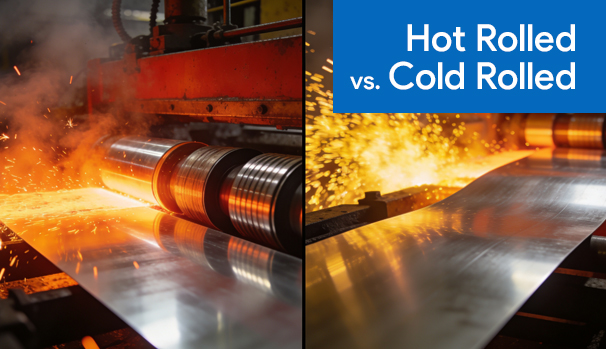
When sourcing aluminium sheets for manufacturing, fabrication, or construction projects, one of the most fundamental decisions you will face is choosing between hot rolled and cold rolled aluminium. These two terms refer to the rolling process used to produce the sheet — and that process has a direct, significant impact on the material’s mechanical properties, surface finish, dimensional tolerances, and suitability for different applications.
For engineers, procurement managers, and fabricators in India, understanding the difference is not merely academic. Specifying the wrong type can result in machining difficulties, surface defects, poor forming performance, or structural shortfalls — all of which translate into project delays and increased costs. Yet the distinction between hot rolled and cold rolled aluminium is often misunderstood or overlooked, particularly by those more familiar with steel rolling processes, where the differences are more widely discussed.
This blog breaks down the hot rolling and cold rolling processes, compares the resulting properties of each, and provides clear guidance on which type of aluminium sheet is best suited to different industrial applications — helping you make an informed sourcing decision every time.
What Is Hot Rolling?
Hot rolling is a metalworking process in which aluminium is rolled at elevated temperatures — typically above the metal’s recrystallisation temperature, which for aluminium alloys is generally in the range of 300°C to 500°C. At these temperatures, the aluminium is highly malleable and can be reduced in thickness by passing it repeatedly between large rollers with relatively low force.
The process begins with a large preheated aluminium slab or ingot. This is passed through a series of rolling mills that progressively reduce its thickness until the desired gauge is achieved. Because the metal is worked at high temperature, internal stresses are continuously relieved as the material deforms — a process known as dynamic recovery and recrystallisation.
Key characteristics of the hot rolling process:
● Performed above the recrystallisation temperature of the alloy
● Requires less rolling force than cold rolling, making it cost-effective for large reductions in thickness
● Produces a relatively rough, matte surface finish due to oxidation at high temperatures
● Results in wider dimensional tolerances compared to cold rolling
● The finished material may exhibit slight warping or surface scale if not properly controlled
Hot rolled aluminium sheets are typically used as a starting material for further processing — either by the end user or through additional cold rolling passes to improve dimensional accuracy and surface quality.
What Is Cold Rolling?
Cold rolling takes place at or near room temperature — well below the recrystallisation temperature of the aluminium alloy. Cold rolled sheets are often produced by further reducing hot rolled aluminium stock through additional rolling passes at ambient temperature.
Because the metal is not softened by heat during this process, significantly greater rolling force is required to achieve thickness reductions. As the aluminium is deformed at room temperature, the crystal structure of the metal work-hardens — a phenomenon known as strain hardening. This increases the strength and hardness of the finished sheet compared to its hot rolled equivalent.
Key characteristics of the cold rolling process:
● Performed at or near room temperature
● Produces a smoother, brighter surface finish with tighter dimensional tolerances
● Increases the strength and hardness of the material through work hardening
● Introduces internal residual stresses, which may require stress-relief annealing for certain applications
● Typically used to produce thinner gauge sheets with precise thickness specifications
● More expensive than hot rolling due to the greater forces and multiple passes involved
After cold rolling, aluminium sheets are often subjected to annealing — controlled heating and slow cooling — to relieve internal stresses and restore a degree of ductility to the material, depending on the temper specification required.
Key Differences: Hot Rolled vs Cold Rolled Aluminium Sheets
Understanding the practical differences between the two processes is essential for correct material selection. The table below summarises the most important distinctions:
| Property | Hot Rolled Aluminium | Cold Rolled Aluminium |
| Rolling Temperature | Above recrystallisation temperature (300–500°C) | At or near room temperature |
| Surface Finish | Rough, matte, may show oxide scale | Smooth, bright, uniform |
| Dimensional Tolerance | Wider tolerances | Tighter, more precise tolerances |
| Strength & Hardness | Lower — softer and more ductile | Higher — work-hardened |
| Internal Stress | Minimal — stresses relieved during rolling | Higher residual stresses present |
| Thickness Range | Typically thicker gauges (plates and heavy sheets) | Thinner gauges, precise sheet products |
| Cost | Lower — less processing required | Higher — greater forces, multiple passes |
| Formability | Excellent — highly ductile | Good, but reduced compared to hot rolled |
| Typical Applications | Structural fabrication, heavy industry, base stock | Precision components, aesthetics, packaging |
Surface Finish and Dimensional Accuracy
One of the most immediately noticeable differences between hot rolled and cold rolled aluminium sheets is their surface finish. Hot rolled sheets have a relatively rough, matte surface. During the high-temperature rolling process, the aluminium surface oxidises, and slight surface imperfections are common. While these can be removed through further processing, as-rolled hot rolled sheet is not suitable for applications where appearance or a smooth surface is important.
Cold rolled aluminium, by contrast, has a smooth, bright, and consistent surface finish. The controlled room-temperature rolling process produces a uniform surface that is suitable for anodising, painting, powder coating, and other surface treatments. For architectural cladding, consumer products, signage, and precision-engineered components, cold rolled sheet is almost always specified.
Dimensional accuracy follows the same pattern. Cold rolling produces sheets with far tighter thickness tolerances than hot rolling, making it the preferred choice wherever precise gauge control is critical — for example, in heat exchanger fins, packaging foil production, and precision-machined components.
Mechanical Properties: Strength, Hardness, and Ductility
The rolling process directly influences the mechanical properties of the finished aluminium sheet, particularly its strength, hardness, and ductility.
Hot rolled aluminium undergoes dynamic recrystallisation during rolling, which relieves work hardening as it occurs. The result is a softer, more ductile material that is easier to form, bend, and weld. Hot rolled sheets are ideal for applications requiring significant subsequent forming operations.
Cold rolled aluminium is work-hardened during rolling, which increases its tensile strength and hardness compared to hot rolled material of the same alloy. This makes cold rolled sheets more suitable for applications demanding higher mechanical performance without the addition of heat treatment. However, this increased strength comes at the cost of reduced ductility — cold rolled sheet is less forgiving in severe forming or bending operations.
It is important to note that the temper designation on an aluminium product — such as O (annealed), H (strain-hardened), or T (thermally treated) — provides additional information about the mechanical condition of the material beyond simply knowing whether it was hot or cold rolled. When specifying aluminium sheets for a particular application, both the alloy grade and the temper should be considered alongside the rolling process.
Which Alloy Grades Are Commonly Available in Each Form?
Both hot rolled and cold rolled aluminium sheets are available across a range of alloy grades, each suited to different applications:
Commonly hot rolled:
● 5083 — High strength, excellent corrosion resistance; used in marine structures, shipbuilding, and pressure vessels
● 5052 — Good strength and formability; used in structural sheet, fuel tanks, and marine applications
● 6061 — Heat-treatable alloy; available as hot rolled plate for structural and engineering uses
Commonly cold rolled:
● 1100 — High purity, excellent formability and corrosion resistance; used in packaging, food processing, and heat exchangers
● 3003 — Good formability and corrosion resistance; used in HVAC, food equipment, and general fabrication
● 5052 — Also available cold rolled for applications requiring a smooth surface finish combined with moderate strength
For buyers sourcing aluminium sheets in India, the availability of specific alloy grades in hot or cold rolled form — and in the required dimensions and temper — depends on the supplier’s inventory depth and sourcing capability.
Choosing the Right Type for Your Application
The choice between hot rolled and cold rolled aluminium sheet ultimately comes down to the specific requirements of your application. As a general guide:
Choose hot rolled aluminium when:
● You require thicker plates or heavy-gauge sheets for structural or load-bearing applications
● Surface finish and tight tolerances are not critical requirements
● Maximum formability and weldability are important
● Cost efficiency for large volumes is a priority
Choose cold rolled aluminium when:
● A smooth, bright surface finish is required — for aesthetic, coating, or hygienic purposes
● Tight dimensional tolerances are critical to the application
● Higher strength and hardness are needed without additional heat treatment
● You are producing thin-gauge precision components, packaging, or heat exchanger fins
When in doubt, consulting with an experienced aluminium supplier who understands both the material properties and the end-use requirements can save significant time and cost downstream.
Why Sourcing from a Trusted Supplier Matters
For both hot rolled and cold rolled aluminium sheets, the quality of the base material — its alloy composition, temper accuracy, dimensional consistency, and surface condition — is fundamental to the performance of the finished product. Poor-quality aluminium sheet can result in forming defects, surface failures after coating, inconsistent machining results, and premature corrosion in service.
Pratham Traders, one of India’s most trusted aluminium suppliers based in Mumbai, stocks an extensive range of aluminium sheets and plates across key alloy grades including 1100, 3003, 5052, 5083, and 6061 — in both standard and custom dimensions. With rigorous quality assurance, mill certifications, and a deep inventory maintained across sizes and alloys, Pratham Traders serves manufacturers, fabricators, and project teams across India with consistent, reliable supply.
Whether your project demands the structural versatility of hot rolled aluminium plate or the precision and finish of cold rolled sheet, Pratham Traders has the right product and the expertise to match it to your needs.
Conclusion
Hot rolled and cold rolled aluminium sheets are not interchangeable — each is the product of a distinct manufacturing process that produces distinctly different material properties. Hot rolling delivers ductility, formability, and cost efficiency for heavy-gauge structural applications. Cold rolling delivers surface quality, dimensional precision, and enhanced strength for thin-gauge, high-finish, and precision-engineered uses.
Understanding these differences is essential for anyone specifying, procuring, or working with aluminium sheet in India’s manufacturing, construction, packaging, or engineering sectors. Getting the specification right from the outset avoids costly errors downstream and ensures the finished product performs as intended throughout its service life.
For expert guidance on selecting the right aluminium sheet for your application, or to explore Pratham Traders’ full inventory, visit prathamtraders.in or call +91 9892485617.
Pratham Traders is a premium aluminium supplier in Mumbai, supplying high-quality aluminium sheets, plates, bars, rods, strips, circles, and coils to manufacturers and fabricators across India.
Frequently Asked Questions (FAQs)
1. What is the main difference between hot rolled and cold rolled aluminium sheets?
The primary difference lies in the temperature at which rolling takes place. Hot rolling is performed above the metal’s recrystallisation temperature (300–500°C), producing a softer, more ductile sheet with a rough surface finish and wider tolerances. Cold rolling is done at room temperature, resulting in a stronger, harder sheet with a smoother surface and tighter dimensional accuracy.
2. Which is stronger — hot rolled or cold rolled aluminium?
Cold rolled aluminium is generally stronger and harder due to work hardening that occurs during the room-temperature rolling process. However, hot rolled aluminium is more ductile and easier to form, bend, and weld. If higher strength without additional heat treatment is required, cold rolled is the better choice. For applications needing significant forming or welding, hot rolled is preferred.
3. Can hot rolled and cold rolled aluminium sheets be used interchangeably?
No, they are not interchangeable. Each process produces distinct mechanical properties, surface finishes, and dimensional tolerances. Using the wrong type can lead to forming defects, surface failures after coating, inconsistent machining results, or structural shortfalls. Always specify the correct type based on your application’s requirements.